
Everyday Portuguese A2
Ask for directions in Portuguese: right, left and straight on
Start with “Desculpe, como posso chegar à biblioteca?” — “Excuse me, how can I get to the library?” Siga em frente means continue straight, vire à direita means turn right, and ao lado de identifies something next to a place. Practise the invented routes below and confirm real directions locally.
- Fact check (oldest dependency):
- Editorial review:
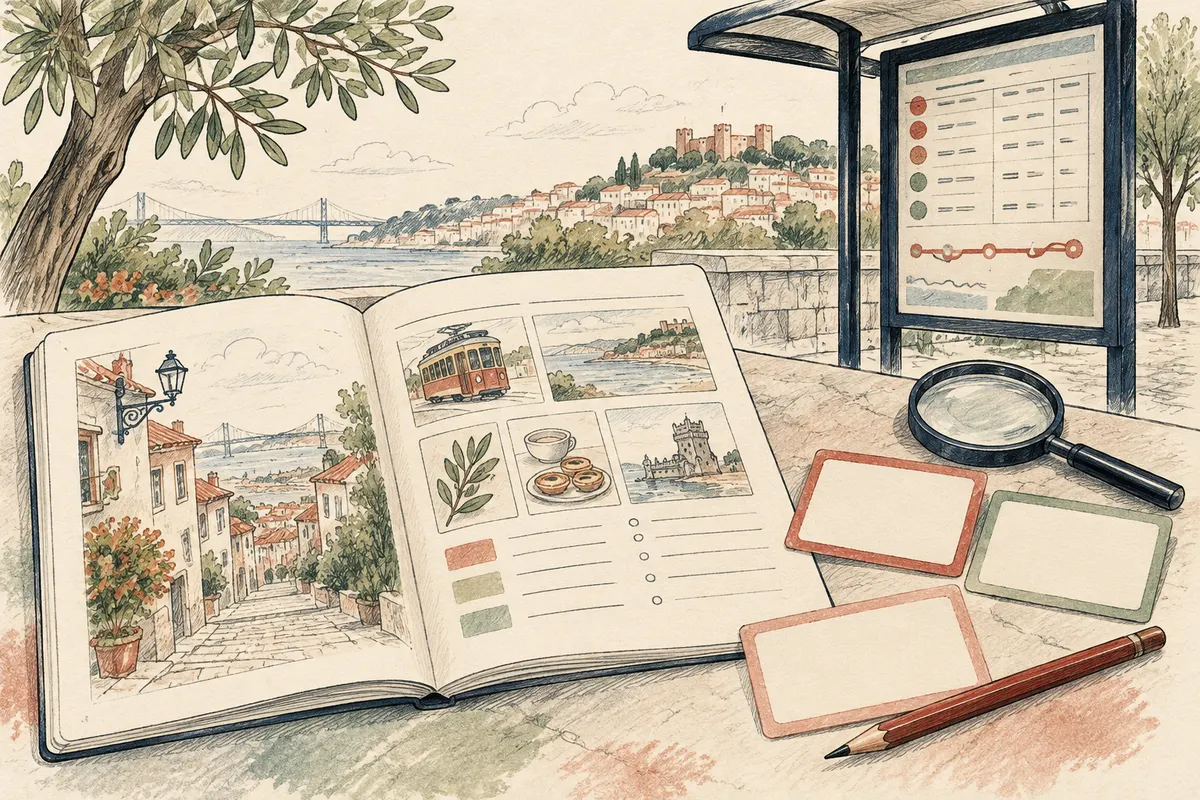
Short answer: destination, stages and landmark
Name the destination first and add the starting point if necessary: “Como posso chegar à biblioteca a partir daqui?” Then listen for a sequence of actions. A building can be a landmark without being the destination. Do not confuse “passe pelo banco” with “entre no banco”: the first instruction has you continue past it rather than go inside.
The table gives short expressions for movements and positions. Right and left depend on the orientation of the person following the directions. If the starting position is unclear, confirm it before choosing a direction. This practice uses an imaginary neighbourhood and does not recommend an actual route or a particular road crossing.
| Portuguese | Meaning |
|---|---|
| Como posso chegar à biblioteca? | How can I get to the library? |
| Siga em frente. | Continue straight on. |
| Vire à direita. | Turn right. |
| Vire à esquerda. | Turn left. |
| Fica ao lado do banco. | It is next to the bank. |
| Fica em frente à escola. | It is opposite the school. |
Ask one useful question at a time
“Onde fica a biblioteca?” requests a location; “Como posso chegar à biblioteca?” invites someone to explain the route. The answers may differ. Start politely with desculpe and ask a concrete question. If you already know the street and only need the entrance, say so: “A entrada fica deste lado?” Avoid asking about the entrance, opening hours and route all at once.
In the dialogue, the visitor receives two stages and confirms the turn. Replace library with school or market while keeping the directions fictional. A short answer does not necessarily mean every detail of your destination was understood. Confirm the name if there are two similar places on your practice drawing rather than assuming they are interchangeable.
Original example for practice
— Desculpe, como posso chegar à biblioteca? — Siga em frente até à praça. Depois vire à esquerda. — Na praça, à esquerda? — Sim. A biblioteca fica ao lado do banco. — Muito obrigado.
Follow a sequence: em frente, depois and até
“Siga em frente até à praça. Depois vire à esquerda” contains an initial action, a limit and a following action. Até à praça does not mean crossing the whole square or turning before reaching it. Separate the message into stages on paper and draw only what was stated. Do not add streets or junctions to fill in missing information.
European Portuguese includes forms such as “até à escola” and “até ao mercado”. In this exercise, focus on the place that ends a stage. If you hear two changes of direction, number them. Repeating only the last word can leave a route incomplete even when you correctly recognise esquerda or direita as individual vocabulary.
Position: next to, opposite and between
“A biblioteca fica ao lado do banco” describes being next to the bank; “fica em frente ao banco” puts the two buildings opposite each other in the exercise map. “Fica entre o banco e a escola” uses two landmarks. Em frente a differs from siga em frente. One describes position while the other directs a movement along the route.
Draw three rectangles and change their labels. Read the sentences before tracing a path with your finger. On the first attempt, explain whether an expression requests an action or identifies a place. This distinction helps when the same familiar word appears both in route instructions and in a description of the final destination’s position.
Worked exercise: reconstruct the route
Read the original directions below. What comes first? Continue straight to the square. Where is the turn? At the square. Which way? Left. What is the final landmark? The library is next to the bank. The text gives neither a distance in metres nor a walking time; do not invent an estimate to complete your answer or make the route sound more detailed.
Now the character has forgotten which way to turn. Ask “Na praça, viro à direita ou à esquerda?” If they missed the final landmark, ask “A biblioteca fica ao lado de quê?” Choose the question according to the missing detail instead of automatically requesting the entire explanation again every time.
Original example for practice
Percurso fictício: Siga em frente até à praça. Na praça, vire à esquerda. A biblioteca fica ao lado do banco.
Partner practice and directions audio
One person draws a small map while the other sees only the starting point. Give two or three stages, request confirmation and compare the destination reached. Swap roles and keep the streets imaginary. When directions are insufficient, the task is to ask for clarification rather than guess your partner’s intention. You can also record your own reading and compare which stages were understood.
The site’s getting-to-the-library audio continues this type of comprehension through a different dialogue. Use the question-words and clarification guides too. CEFR and Camões provide the educational framework; maps, phrases and solutions here are editorial materials. They are neither real navigation instructions nor official CIPLE examination tasks.
Confirmed by official source
The CEFR describes A2 as simple, direct communication in routine tasks on familiar matters and simple descriptions of personal background and immediate needs.
Last checked:Confirmed by official source
Referencial Camões PLE is a didactic resource with CEFR level descriptors and inventories of language functions, notions and grammar.
Last checked:Sources and scope of this guide
Official sources support the stated legal, language and certification facts. Plans, examples and checklists are independent editorial suggestions, not instructions from an authority.
Continue here
Practise Portuguese A2 for free
Original learning exercises with explanations. This is not a CIPLE exam.
Have a question?
Choose a topic to contact the project. This is not legal advice or an official application.
Test mode: only fictional details are sent. Do not enter personal data.
The server queue retains delivered requests for 7 days. This form does not create an account or subscription. Privacy.